Metal Art & History
Behind the Beast: The Art of Derek Riggs
Derek Riggs is an English illustrator best known for creating Eddie the Head, Iron Maiden‘s iconic skeletal mascot. He was largely self-taught as a painter, though he attended art school before pursuing illustration professionally. His big break came in the late 1970s/early 1980s, when he was walking around London record companies with a portfolio.
Riggs had already painted the image that became Eddie about a year and a half before Iron Maiden used it. It wasn’t even called Eddie at the time. The painting was titled “Electric Matthew Says Hello” and depicted a gaunt, undead-looking figure with a punk-inspired appearance. Riggs had created it independently and kept it in his portfolio. Iron Maiden‘s manager eventually saw Riggs‘s portfolio and became interested. That painting became the cover of Iron Maiden‘s 1980 debut album.

From Portsmouth to Iron Maiden
Born in Portsmouth, England, in 1958, Riggs began drawing at an early age and developed a fascination with horror, science fiction, natural history and comic-book art. He has cited artists such as Jack Kirby as an influence, not because he wanted to copy their work, but because their exaggerated and highly stylized images demonstrated how an artist could create an entire world on a page.
When manager Rod Smallwood selected “Electric Matthew Says Hello,” Riggs was asked to give the character more hair around the sides of his head. The original figure’s shorter, punk-like appearance was reshaped to better fit the emerging heavy-metal audience. That revision helped establish the visual version of Eddie recognized around the world today.
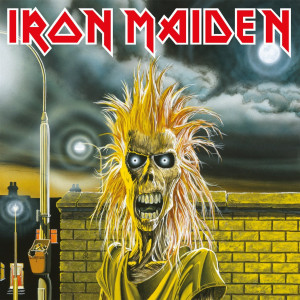
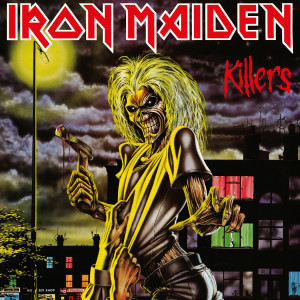
Riggs went on to create the cover artwork for every Iron Maiden studio album released during the 1980s. He also produced artwork for singles, posters, tour programs, merchandise and the landmark live album Live After Death. His final regular Maiden studio-album cover was 1990’s No Prayer for the Dying, although he made occasional contributions to the band afterward.
Eddie Never Stood Still
Making Eddie evolve is what separated Riggs from someone simply drawing the same mascot repeatedly. Riggs explained that Iron Maiden would sometimes give him a broad direction such as Egyptian, science fiction, etc. and then he’d develop much of the actual visual concept himself. Riggs built entire worlds based off of a simple theme.
For Killers, he’s a murderous street-level horror character.
For Number of the Beast, he’s a puppet master.
For Piece of Mind, he’s institutionalized.
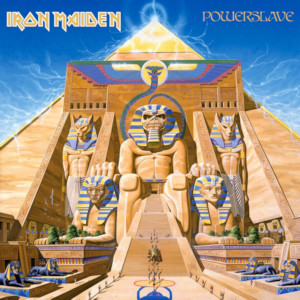
For Powerslave, he’s transformed into an Egyptian deity.
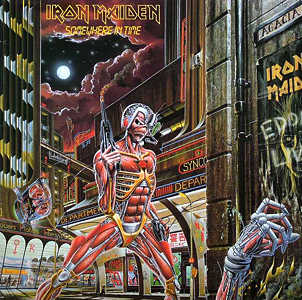
For Somewhere in Time, he’s a futuristic cyborg surrounded by a giant cyberpunk city.
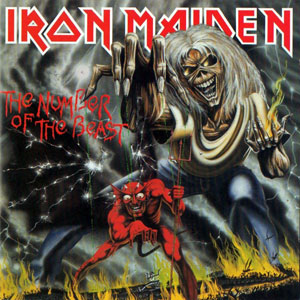
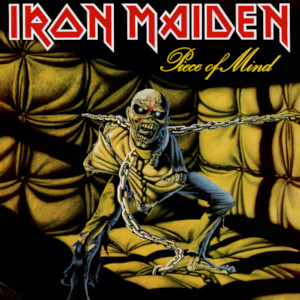
Worlds Hidden Inside the Covers
The covers became increasingly ambitious as the band grew. Early assignments could arrive with extremely tight deadlines, sometimes leaving Riggs only a few days to complete an image. By contrast, the wraparound artwork for Somewhere in Time took approximately two and a half months.
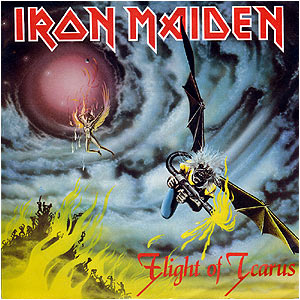
Its Blade Runner-inspired city is filled with references to Maiden’s history. “Acacia” points toward “22 Acacia Avenue,” a clock reads 23:58 in tribute to “2 Minutes to Midnight,” and signs reference the Ruskin Arms, Long Beach Arena, “Phantom of the Opera” and Steve Harris’s first band, Gypsy’s Kiss. A burning Icarus recalls the “Flight of Icarus” single, while a West Ham football score pays tribute to Harris’s beloved club.
Look for Riggs’s signature
Riggs often hid his personal symbol inside the artwork. It resembles a small angular cartouche and can be spotted on many of his Maiden images—including on the cyborg Eddie’s chest in Somewhere in Time. Searching for it became another part of studying the covers.
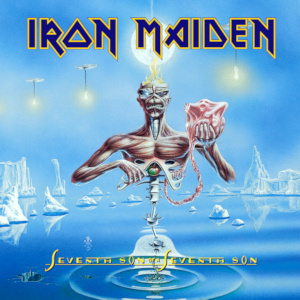
On Seventh Son of a Seventh Son, Riggs moved away from the dense city of Somewhere in Time. Eddie’s body is largely gone, his head and torso float above a frozen landscape, and a small flame burns in the palm of his hand. The stripped-down composition proved that Riggs did not need a crowded background to make an image mysterious—or deeply strange.
Stories on a Single Sleeve
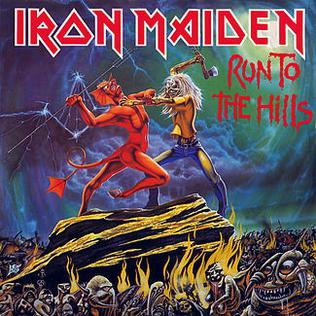
The singles allowed Riggs to extend Eddie’s adventures beyond the albums. The “Run to the Hills” artwork turned him into a tomahawk-wielding combatant, while “Flight of Icarus” presented him as a winged executioner using a flamethrower. Even when reduced to the size of a seven-inch sleeve, the images still suggested an entire story occurring beyond the frame.
Paint, Poison and the Digital World
Many of Riggs’s classic covers were painted on illustration board with acrylics and alkyds, a fast-drying oil-based medium. This allowed him to build smooth surfaces and sharp detail, but years of exposure to paint chemicals affected his health. He eventually moved away from traditional painting and embraced digital tools.
For Riggs, the computer was not simply a shortcut. It eliminated days spent waiting for layers of paint to dry and allowed more time for constructing and refining the actual image. Whether working with brushes or software, his purpose remained the same: create a central character strong enough to command an album sleeve, poster or T-shirt.
Life Beyond Eddie
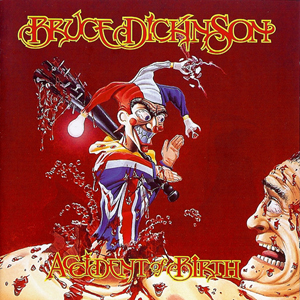
Although Eddie will always dominate any discussion of Riggs, his work extends beyond Iron Maiden. He created artwork for bands and artists including Gamma Ray, Stratovarius and Bruce Dickinson. His cover for Dickinson’s 1997 solo album Accident of Birth introduced a sinister jester-like puppet nicknamed “Edison”—a dark joke meaning “Eddie’s son.”
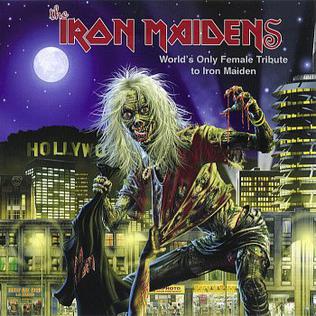
Riggs also returned to familiar territory for the 2005 debut album by all-female tribute band The Iron Maidens. His cover introduced Edwina T. Head, a female variation on the type of monstrous character that made his Maiden work instantly recognizable.
A Brief Conversation with Derek Riggs
I had the opportunity to briefly speak with Derek Riggs while he was at a local record store signing vinyl and merch, and I got to ask him a couple of questions about his work.
Q: Did you design Eddie with a particular personality or story in mind?
A: Eddie wasn’t a person. Eddie was a symbol for wasted youth. It was during the punk period that I was trying to work it out because metal had died. It was a pain.
Q: Would you redesign him today if you had the chance?
A: No, he was done right the first time. I know what I’m doing.
The music gave Iron Maiden its identity.
Riggs gave that identity a face.