Album Review
Green Lung
This Heathen Land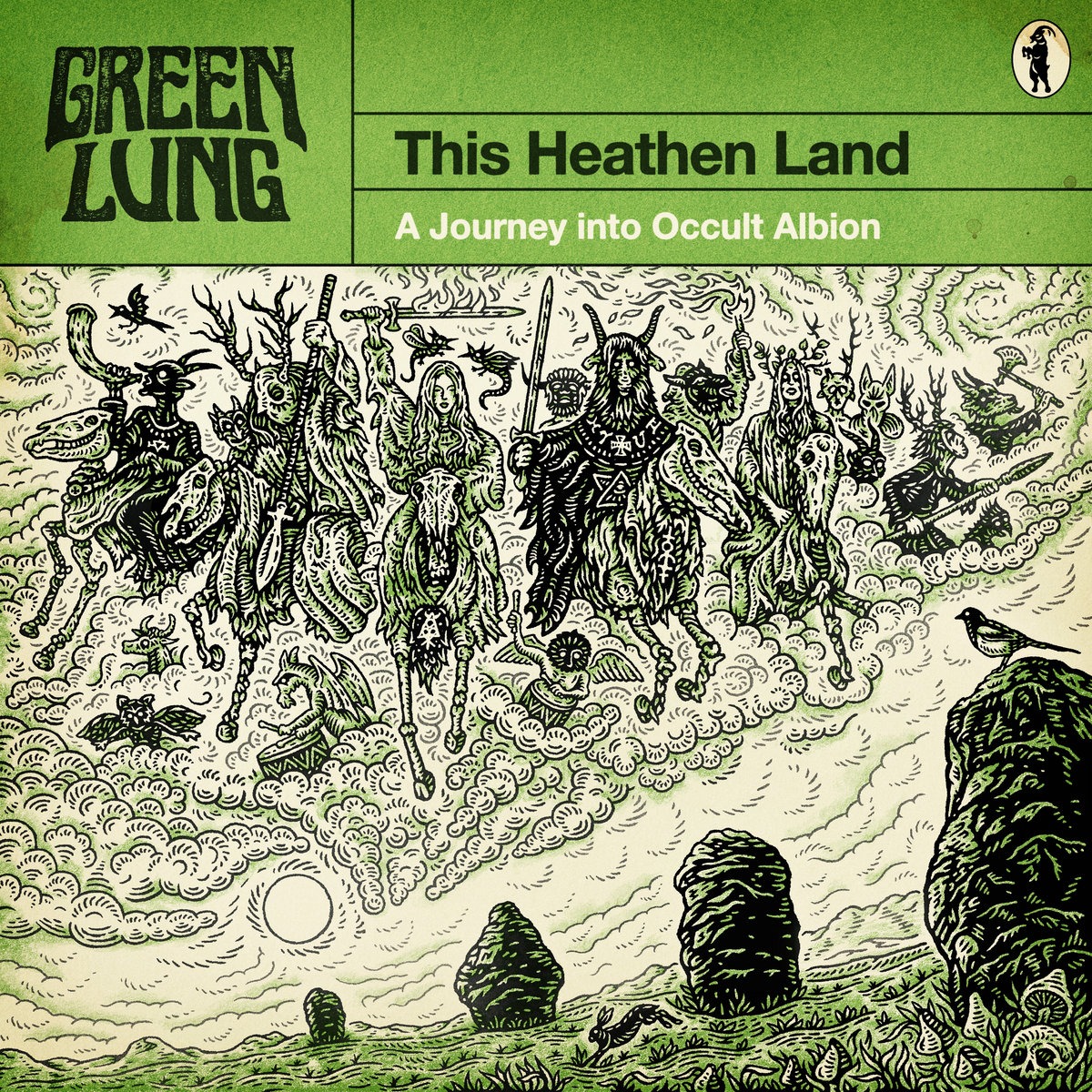
- Band
- Green Lung
- Album
- This Heathen Land
- Label
- Nuclear Blast
- Genre
- Stoner/Doom
- Release
- November 3, 2023
- Review By
- Negalithic
- Rating
- 9/10
With Green Lung’s new album approaching, this felt like the right moment to return to This Heathen Land and reconsider the record in light of the praise and criticism that followed it. It was widely hailed as the band’s most ambitious and accomplished work, though some listeners felt its layered production, theatrical vocals and stylistic breadth occasionally came at the expense of immediacy, cohesion and some of the band’s earlier doom weight. Green Lung have always been more than another Sabbath-descended occult rock band; their best songs are built with a rare understanding of folklore, landscape, history and the strange persistence of the past beneath modern Britain. Revisiting This Heathen Land track by track reveals both how carefully its world was constructed and why the leaner, more forceful direction suggested by the new singles may represent not a rejection of that record, but the next stage of the same journey.
Released November 3, 2023, Green Lung’s third album is the point where they moved beyond folk-horror-themed stoner doom and became full-on guides to a well-researched occult Albion populated by witches, magpies, barrow kings, wild hunts, ley lines and doomed lovers. Tom Templar framed the album as an odyssey through British folklore, with its songs tied to specific landscapes, legends and stories (Carter). That required a record broad enough to hold doom, pop, prog, acid folk and classic rock influences without losing the band’s core identity. The album is governed by its sense of place. Nearly every song is tied to a landscape, historical figure or legend: Pendle Hill, Alderley Edge, Dartmoor, Wistman’s Wood, old tracks, stone circles, Whitby and Whitechapel. The vinyl packaging even included a map of the sites and stories covered by the songs.
Musically, it pushes beyond the fuzzier Electric Wizard/Cathedral end of Green Lung’s beginnings. The core remains Sabbathian—thick riffs, ominous intervals, doom-struck rhythm guitar—but This Heathen Land increasingly draws on Rainbow, Deep Purple, Queen, Ghost and ’70s progressive hard rock. John Wright’s Hammond is a co-lead instrument with Scott Black’s guitar, while Templar’s vocals hit greater melodic highs than in the past. If the record is harder to place than previous efforts, it is because it draws on a time when hard rock, doom, prog and metal were far less rigidly separated. It is lush, theatrical and highly composed, and for some that might have been a negative on its initial release. Let’s take the record on a song-by-song basis:
“Prologue”
The spoken introduction is only 55 seconds, but rather than functioning as generic occult ambience, it frames the album as a documentary journey through an alternative Britain: lonely tors, old woods, standing stones, half-remembered histories. It sounds like an excerpt from an unsettling schools television program, the sort of thing that would have permanently damaged generations of children. We are being given a map and instructed to travel, making This Heathen Land feel almost like a concept album without forcing every song into one continuous narrative. Musically, it delays gratification; atmosphere first, riffs second. On a full record listen, where it begins the guided journey, it’s essential.
“The Forest Church”
If This Heathen Land has a mission statement, this is it. Rather than easing the listener in with atmosphere, the song cracks right into a confident, mid-tempo riff. Scott Black’s guitar immediately establishes familiar Green Lung territory, while John Wright’s Hammond quickly weaves around it, echoing a more progressive chapter of British heavy rock. It has the steady, processional quality of a congregation moving toward an altar, summoning the band’s faithful. The lyrical conceit is classic Green Lung: an abandoned woodland church reclaimed by pagan vegetation and repurposed for Satanic worship. Briars engulf the stonework, smoke hangs beneath the rafters, graves crumble back into the earth, and the congregation descends willingly into the old faith. The song’s clear nod to The Blood on Satan’s Claw, one of British folk horror’s so-called Unholy Trinity, gives Templar one of his strongest pieces of world-building: you can picture every moss-covered stone. By the time Templar is inviting you into the forest church, you’ve already started humming along. If it has a weakness, it is that it establishes a blueprint the rest of the album sometimes refines rather than surpasses.
“Mountain Throne”
The riff has a springy quality rather than a funereal doom crawl. Matt Wiseman’s drumming gives it forward momentum, and Joseph Ghast’s bass adds a rolling undertow. Lead lines flourish like weather squalls as we ascend Pendle Hill. The lyrics center on the notorious Pendle witches, including Demdike and Chattox, and imagine a coven ascending from caves and valleys to reclaim the mountain. Malkin Tower is reconstructed; accused witches return as rulers, while the mountain itself becomes a sacred seat. Demdike and Chattox lead us out onto the hill, and this time, nobody comes to hang them. The song could almost be a scene from one of Tarantino’s revisionist revenge histories; if “The Forest Church” directly evokes The Blood on Satan’s Claw, then “Mountain Throne” feels like a thematic reversal of Witchfinder General: the accused return, seize the pulpit and reclaim the power from those who condemned them. Despite its layered vocals and organ, everything serves the central riff’s marching motion. And credit is due for rhyming “tall” and “phantasmagorical.”
“Maxine (Witch Queen)”
If you are someone who thought this album sounded like Ghost, this song is probably the reason. Musically, it moves closer to Ghost, Queen and glam-tinted ’70s hard rock than conventional doom, with a jubilant stuttering organ riff that recalls “Square Hammer.” It is the album’s most compact and immediately accessible song, getting right into a singable chorus. Yet where Ghost generally use occultism as part of an invented Satanic theatre, Green Lung anchor the song in a real woman, Maxine Sanders, a crucial figure in modern British witchcraft and Alexandrian Wicca. Templar is not writing historical biography. He imagines her through memory, infatuation and occult romance: Alderley Edge, Notting Hill Gate, Beltane initiation and a lover still cursed by recollection. The name “Maxine” functions as both hook and incantation. Wright does not lurk behind the riff; he sparkles, swirls and pushes the song toward bright theatricality. The vocals likewise give it a flamboyant, almost cabaret quality.
“One for Sorrow”
For me, it is the emotional heart and centerpiece of the album. The title and imagery come from the magpie-counting rhyme, but the song gradually reveals that the bird is a metaphor for the narrator’s persistent depression or melancholy. He does not simply fear an omen; he recognizes sorrow as something that has always accompanied him and always will. The composition responds by slowing the album down. The riff is massive and downward-pulling, closer to doom proper than the buoyant occult rock we just heard in “Maxine.” The magpie’s tapping at the window is classic gothic imagery, but the chorus strips away the folklore disguise, exposing a vulnerability rarely foregrounded in Green Lung’s work.
The arrangement is impressively patient. The band lets the central riff carry emotional weight rather than constantly changing sections. When the counting rhyme arrives—altered into increasingly ominous images of funerals, hell and the devil—the childhood charm has been contaminated by adulthood. At its best, the performance sounds exposed and haunted, while sometimes drifting into theatrical excess. The public rituals of the opening tracks have given way to private memory and psychological burden, another sign of the album’s careful sequencing.
“Song of the Stones”
After the dense conclusion of Side A, “Song of the Stones” opens into a more spacious, if uneasy, form of catharsis. Acoustic textures, hovering vocals and atmospheric guitar replace the dominant Hammond-and-riff attack. It is not a metal song with an acoustic introduction; it is essentially an acid-folk composition performed by a metal band.
The narrator wanders counterclockwise around a barrow after consuming a mysterious substance, hears a pulse beneath the earth and enters a circle of standing stones. A door opens, revealing worshippers gathered before the Barrow King. What ancient power is calling the narrator home? The attraction is stronger than fear. That is quintessential folk horror: the supernatural is not an intrusion, but something older to which the protagonist may already belong.
The vocals are soft and layered rather than declamatory. The rhythm feels cyclical, as though the song could continue around the stones indefinitely. Scott Black’s lead guitar is restrained and lyrical, with spacious, vocal phrasing. The field-recording atmosphere matters too. The album credits include recordings made in Fritton Woods, Norfolk, reinforcing the sense that the natural environment is not merely being depicted but has entered the recording itself.
“The Ancient Ways”
This is the album’s most explicit declaration of occult philosophy, following a solitary figure through old straight tracks, holloways, sacred ley lines and mythic woodland, using dowsing and psychedelics to access a hidden landscape. References to Lavondyss and the “mythago” place the song partly in the lineage of Robert Holdstock’s fiction, where landscape stores archetypes and ancestral memory. We are walking into a collective unconscious where nature is not scenery but an intelligence capable of rearranging perception.
Musically, “The Ancient Ways” is where Green Lung’s doom, prog and melodic hard-rock instincts fuse most naturally. The riff is heavy but spacious; the solos are incandescent. The organ has an exploratory, hallucinogenic quality, blooming as the ancient ways present themselves.
“Hunters in the Sky”
It is probably the album’s most complete heavy-rock performance. The song invokes the Wild Hunt above Dartmoor and Wistman’s Wood, but Templar ties the supernatural hunt to the struggle over land ownership. The quarry is someone who attempts to lay claim to the moor, and the song ultimately declares that no person can own what is common to all, giving it a political edge. The myth becomes an avenging force against enclosure, privatization and the ownership of common land.
Musically, it gallops without turning into Iron Maiden. The rhythm has the propulsion of a hunt, while the Hammond and guitar engage in one of the record’s best exchanges. This is where Deep Purple and Rainbow are most deeply embedded in Green Lung’s language. Jon Lord-style organ fireworks soundtrack spectral hounds crossing Dartmoor in defense of common land. Templar shifts between narration, warning and participation. By the chorus, the band are no longer describing the Wild Hunt. They are the Wild Hunt. It is among Green Lung’s finest songs, perhaps the clearest example of their folk-horror concept fully inhabiting the music rather than merely decorating it.
“Oceans of Time”
The album closes with an unabashedly romantic and theatrical song. Its setting draws on Bram Stoker’s Whitby, while its vision of Dracula pursuing a reincarnated lost love owes more to Francis Ford Coppola’s film than to the novel itself. Musically, it is another song that invites a Ghost comparison. The keyboards broaden into cinematic washes, the chorus is openly sentimental, and the vocal arrangement aims for Queen-sized drama. After traveling through Britain’s occult landscapes, the record ends with its widest geographical and temporal sweep: Transylvania, Yorkshire and London connected across the centuries.
The central chorus is strong, but the song keeps reinforcing an emotional point it has already delivered. The production is lush enough that the danger drains away: Dracula becomes less an ancient predator than a doomed romantic. “Hunters in the Sky” would have provided a more forceful ending, though “Oceans of Time” offers the more sweeping theatrical curtain call.
Taken together, This Heathen Land stands as Green Lung’s most complete and carefully constructed statement: a record whose riff-driven rock, acid-folk interludes and gothic melodrama are all placed in service of a coherent journey through Britain’s haunted landscape. Its attention to theme goes far beyond occult window dressing, drawing with purpose on folk-horror cinema, real occult history and mythic fiction, while allowing each song’s musical character to reflect its story. The result is broad without feeling scattered, moving from communal invocation and historical reclamation to private sorrow, ecstatic surrender and romantic excess. Yet that richness also brings the album close to the limits of Green Lung’s increasingly layered, theatrical approach.
The first two Necropolitan singles suggest a deliberate tightening of that machinery. “Evil in This House” is the more familiar Green Lung song: a crunchy Sabbath riff, haunted-house atmosphere and a chorus built for a live sing-along. Its inspiration in 50 Berkeley Square keeps things rooted in place, this time urban rather than the pagan wilds. The stripped-back arrangement gives the rhythm section more force and makes the keyboards feel more sinister. “Necropolitan Line” is the clearer departure. Its Motörhead-like speed and frantic guitar-organ duel replace the band’s usual stately procession with something dirtier and more reckless. Drawing on the London Necropolis Railway, which carried corpses and mourners to Brookwood Cemetery, and the subterranean horror of Death Line, it compresses Green Lung’s historical storytelling into a fast piece of rock ’n’ roll. It sacrifices some atmosphere for momentum, but also sounds more dangerous than much of This Heathen Land. Scott Black has called the new record a kind of “punk Black Sabbath” album, and much of it was recorded at Rockfield Studios (Ruskell). The singles support that description, but neither suggests Green Lung are reversing course so much as concentrating their strengths. Green Lung have not abandoned the heathen land; they have discovered it beneath London.
Sources
Carter, Emily. “Green Lung Announce Third Album This Heathen Land, Release Single ‘Mountain Throne.’” Kerrang!, 7 Aug. 2023, kerrang.com. Accessed 31 July 2026.
Ruskell, Nick. “Green Lung: ‘I Can’t Think of a More Occult City Than London. You’re Never More Than a Few Streets Away from Something Arcane and Weird.’” Kerrang!, 13 May 2026, kerrang.com. Accessed 31 July 2026.
Green Lung Are
- Tom Templar — vocals
- Scott Black — guitar
- Joseph Ghast — bass
- John Wright — keyboards/Hammond
- Matt Wiseman — drums
Watch