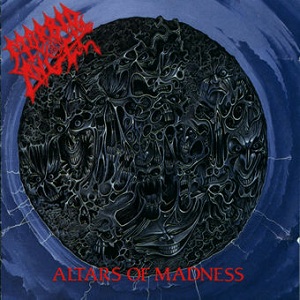
Altars of Madness erupted onto the scene in 1989, with its whirlwind riffs, blasphemous intensity, and occult-drenched atmosphere. Blending technical chaos with almost spiritual ferocity, Altars of Madness dragged the genre into darker, faster, and more unrelenting territory. Over three decades later, its impact remains seismic.
The production of Altars of Madness, handled by Tom Morris and the band at Morrisound Recording, is raw yet strangely precise — a perfect storm of grit and clarity. The guitars, courtesy of Trey Azagthoth and Richard Brunelle, are jagged and chaotic, layered in such a way that they seem to coil around each other in a ritualistic frenzy. Pete Sandoval’s drumming is feral, his blast beats surgically tight, and his fills sound like they’re being channeled from another dimension. David Vincent’s guttural vocals punch through the mix like a preacher possessed, giving the record its menacing, otherworldly authority.
The album art for Altars of Madness is a painting by Dan Seagrave, depicting a flat disk of fossil material capturing souls. Seagrave described it as not intended to be spherical, but rather a flat disk that is slowly petrifying souls.
Now let’s get into the tracks!
“Immortal Rites”
The song explores themes of seeking transcendence, embracing darkness, and pursuing immortality through the invocation of ancient, otherworldly entities. It conveys a sense of yearning for a higher power to cleanse and enlighten, as well as a desire to escape the limitations of human existence.
The lyrics describe a gathering for a sacred rite, where the subconscious minds of those involved join forces to call upon the “immortals,” the oldest beings known, to intervene on their behalf. Their aim is purification — to be cleansed and to become one with the darkness. They seek enlightenment and a deeper understanding of the ways of these ancient entities.
The second verse introduces haunting voices and shadowy, faceless beings — lost for centuries, brimming with wisdom beyond comprehension. Their undefined origins heighten the song’s mystery. The chorus boldly declares the summoning of the “Lords of death” to reside within the minds of believers. This act of summoning isn’t passive — it’s an invitation to be reshaped by their powers and granted the gift of immortality.
The guitar solos add a haunting, atmospheric quality, enhancing the song’s mystical feel. The final line, “Now immortal,” drives home the message: transcendence has been achieved.
Overall, “Immortal Rites” is a dark meditation on the human desire to overcome mortality and attain forbidden knowledge. Deep stuff here, folks.
“Suffocation”
This is a raw, suffocating storm of death metal fury. Clocking in at just under three minutes, it’s a relentless barrage that shows the band’s foundational role in shaping the genre. From the opening riff, Trey Azagthoth’s signature chaotic guitar work hits hard — angular, almost alien in melody, both feral and calculated. His solos erupt rather than play, tearing through the mix like unhinged spirits.
Pete Sandoval, aka “Commando,” delivers some of the most intense drumming on the album. His blast beats are mechanical yet organic — it’s as if his limbs are possessed. His performance on “Suffocation” helped set the standard for extreme drumming in death metal.
David Vincent’s vocals are cavernous — less of a growl and more a declaration of war. His tone doesn’t rely on effects; it’s pure lung power. The lyrics are cryptic, violent, and soaked in spiritual decay and existential dread. It’s not a narrative — it’s a feeling, like being caught in a spiritual chokehold. Take a listen.
“Visions from the Dark Side”
This is a ferocious blast of old-school death metal. The lyrics describe a protagonist haunted by shadows, pursued through a bleak, malevolent world. “Pits of hate” and monk-like figures symbolize inner torment and moral collapse.
The second verse speaks of toxic memories, decay, and “dogs of war,” representing the devourers of innocence. The protagonist sees the futility of conflict — no victory, only endless corruption. The chorus reveals a surrender to darkness, a resigned acceptance of its irresistible pull.
Crushing riffs, guttural vocals, and relentless drumming conjure an atmosphere of occult horror. A must-hear for extreme metal purists and newcomers alike.
“Maze of Torment”
A relentless assault of chaotic energy, “Maze of Torment” is driven by Pete Sandoval’s blistering drumming and Trey Azagthoth’s dissonant, unpredictable riffs. The result is a nightmarish soundscape that lives up to its name.
David Vincent’s vocals add to the apocalyptic tone. The song structure itself — wild tempo shifts and disorienting changes — evokes the feeling of being trapped in a psychological labyrinth. It’s a standout track that helped cement Morbid Angel’s legacy.
“Chapel of Ghouls”
One of my personal favorites. Raw, punishing, and dripping with unholy atmosphere, it opens with a vortex of chaos. Trey Azagthoth’s guitars slash like ritual knives, unleashing demonic tremolo fury. David Vincent roars like a beast from the abyss, commanding the damned. Sandoval’s drumming is relentless, a storm of blast beats from a hellish forge.
The eerie mid-section, with chanting and a crawling rhythm, feels like a descent into a cursed crypt. Then it explodes again in feral rage. “Chapel of Ghouls” is not just a song — it’s an invocation. A declaration of war against musical complacency. Brutal, iconic, essential.
“Bleed for the Devil”
Do I need to say more? This is a high-velocity blast of early death metal fury. In under three minutes, it unleashes chaos. Trey Azagthoth’s riffs and solos burn with deranged energy, while Pete Sandoval’s precision drumming propels everything forward.
David Vincent’s venomous delivery brings the lyrics — steeped in Satanic devotion and self-sacrifice — to life. The structure is tight yet unpredictable, reflecting the track’s violent themes. This is Altars of Madness distilled: aggression, occultism, and instrumental extremity. A savage anthem of darkness.
“Damnation”
This one explores themes of evil, destruction, and religious corruption. The first verse references paganism, necromancy, and the decay of sacred texts — symbols of the erosion of morality.
Verse two critiques organized religion, portraying a mastermind leading Christians astray. With burning crosses and holy war imagery, it implies divine abandonment: “God weeps and turns his back.” The chorus evokes plague and tyranny, painting a world overrun by malevolent forces.
The instrumental passages amplify the despair. The third verse portrays urban decadence, unholy rituals, and societal collapse. The protagonist, trapped and hopeless, sees no escape from destruction — not even in death.
“Damnation” is a brutal critique of religious manipulation and societal decay. Bleak, powerful, unforgettable.
“Blasphemy”
Short but utterly punishing, “Blasphemy” is a violent outburst of anti-religious rage. Clocking just over a minute, it’s pure aggression — no frills, no subtlety.
Pete Sandoval’s drums hammer like a machine gun. Trey Azagthoth’s riffs are warped and filthy. David Vincent spits venom, his voice a weapon of desecration. The lyrics reject religion outright. It’s a sonic crucifixion — pure death metal fury, condensed into a single violent moment.
“Evil Spells”
The final track, “Evil Spells,” closes the album with a fittingly ominous and crushing finale. Opening with blistering tremolo riffs and relentless drumming, it plunges you into a chaotic ritual. Azagthoth’s dissonant leads twist and writhe like summoned demons.
Vincent’s guttural proclamations summon ancient forces. The pacing is unrelenting, with eerie atmospheric moments that let the dread set in before the next assault. It feels like a ritual — violent, unholy, and drenched in arcane menace. A perfect closer to a monumental album.
My Final Thoughts…
Decades later, Altars of Madness remains one of the most important death metal albums of all time — if not the most important. It laid the groundwork for the genre’s expansion into more technical and aggressive realms, and it continues to influence bands across subgenres: brutal death, blackened death, technical death metal — you name it.
It’s the sound of a band not only defining a genre but pushing it far beyond what anyone thought possible in 1989.
Decades later, it’s still a towering, untouchable monument to unfiltered creative fury. Take a listen — and you’ll probably agree.